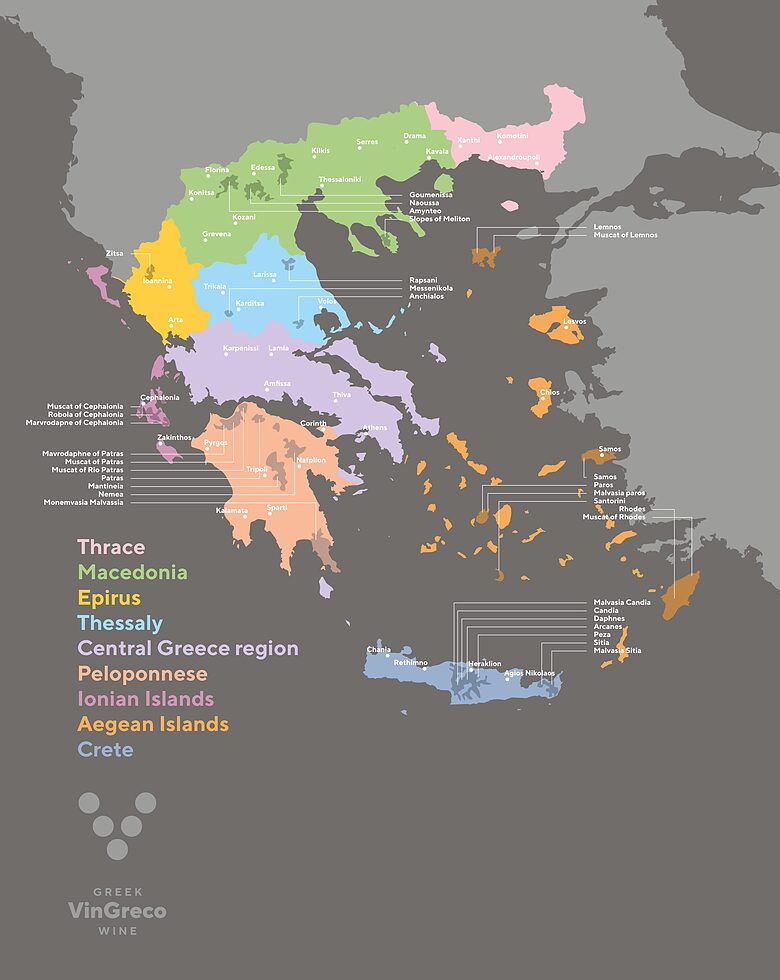
Major Greek PDO Appellations
Among Greece’s 33 PDO appellations, the following are the country’s most important wine regions, representing a wide range of terroirs and styles.
PDO Santorini
Santorini is probably Greece’s most distinctive wine region. Its vineyards grow in volcanic, sandy soils with very little clay, where phylloxera has never become established. As a result, Santorini’s vines remain ungrafted, growing on their own roots. To cope with the intense sun, drought and strong Aegean winds, vines are traditionally trained in the low, basket-shaped kouloura. The PDO Santorini zone also includes vineyards on the neighbouring island of Thirassia.
Assyrtiko is the dominant grape variety and gives Santorini its characteristic dry white wines — powerful and structured, with high acidity and a distinctive saline, mineral character. The island became a reference point for high-quality Greek white wine during the country’s modern wine revival and remains one of its most internationally recognised appellations.
Dry Santorini is traditionally associated with two broad expressions of Assyrtiko: a taut, unoaked style, usually matured in stainless steel and commonly labelled Santorini, and the richer Nykteri style. Made from riper Assyrtiko grapes, Nykteri is fuller-bodied, higher in alcohol and matured in oak for at least three months.
Vinsanto is Santorini’s historic sweet wine, made from very ripe white grapes that are dried in the sun before fermentation. The wine then undergoes extended aging. Assyrtiko forms the backbone of the blend, traditionally accompanied by Aidani, Athiri and other local white varieties. Its concentrated sweetness is balanced by Santorini’s naturally high acidity, giving Vinsanto remarkable intensity and aging potential.
PDO Naoussa
PDO Naoussa lies on the eastern slopes of Mount Vermio in northern Greece. It is the largest of Greece’s four Xinomavro PDOs and one of the variety’s benchmark regions, with Xinomavro as the sole grape permitted for PDO Naoussa wines. Vineyards lie between approximately 80 and 350 meters, with differences in elevation, aspect and soils — ranging from acidic, schist-derived soils to lime- and clay-rich soils — creating marked variation across the region. A detailed terroir study identified six climatic zones and 13 subzones, highlighting the complexity of Naoussa’s vineyard landscape.
Xinomavro here produces structured red wines with high acidity, firm tannins and excellent aging potential. Traditionally associated with austere, long-lived wines, Naoussa today shows a broader stylistic range, as producers increasingly use gentler extraction and different maturation approaches to create fresher, more refined expressions.
PDO Amyndeon
PDO Amyndeon is one of Greece’s coolest wine regions. Its vineyards lie on a high plateau at approximately 570–750 meters, surrounded by the Vermio, Vitsi and Voras mountains. Lakes Vegoritida and Petron help shape the region’s strongly continental-influenced climate, while its predominantly sandy soils have helped preserve many old, ungrafted vines.
Like Naoussa, PDO Amyndeon is based entirely on Xinomavro, but the variety takes on a distinctly different expression in this cooler, high-altitude environment, often producing lighter, fresher and more refined wines that become approachable earlier. Alongside dry red wines, the appellation also produces dry rosé and sparkling rosé wines, highlighting the versatility of Xinomavro.
PDO Nemea
PDO Nemea in the northeastern Peloponnese is Greece’s largest red wine appellation and the principal region for Agiorgitiko, the sole grape variety permitted for Nemea PDO wines. Vineyards extend from valley floors and rolling hills to mountain slopes at approximately 270–800 meters, resulting in considerable differences in temperature, exposure and ripening conditions. Valley soils are generally fertile and alluvial, while many hillsides are less fertile and rich in active limestone.
This diversity is reflected in a broad range of Agiorgitiko styles, from supple, fruit-driven reds to richer, structured wines with excellent aging potential. Increasing attention to individual sites and single-vineyard wines is revealing a much more complex terroir than Nemea’s traditional broad altitude-based classification might suggest.
PDO Mantinia
Located on a high plateau in the central Peloponnese, PDO Mantinia is the classic home of Moschofilero. The plateau lies at an average altitude of around 660 meters, with surrounding vineyard slopes reaching up to 800 meters. Mantinia is one of Greece’s coolest PDO regions, and its high altitude and cool climate allow Moschofilero to ripen slowly while retaining its naturally high acidity and distinctive aromatic profile.
Mantinia is best known for fresh, aromatic dry white wines, typically showing floral, rose and citrus notes. The appellation also produces sparkling white wines, for which Moschofilero’s naturally high acidity makes it particularly well suited.
PDO Samos
The eastern Aegean island of Samos is one of Greece’s historic centers of sweet wine production. PDO Samos wines are produced from Muscat White, grown on steep, terraced vineyards that rise from the coast to around 800–900 meters, with the main vineyard area concentrated in the north.
The appellation includes both naturally sweet wines made from sun-dried grapes and fortified sweet wines. Muscat’s intense aromatic character, mountain viticulture and the island’s long winemaking tradition have made Samos one of Greece’s benchmark regions for dessert wines.